September 24, 2026
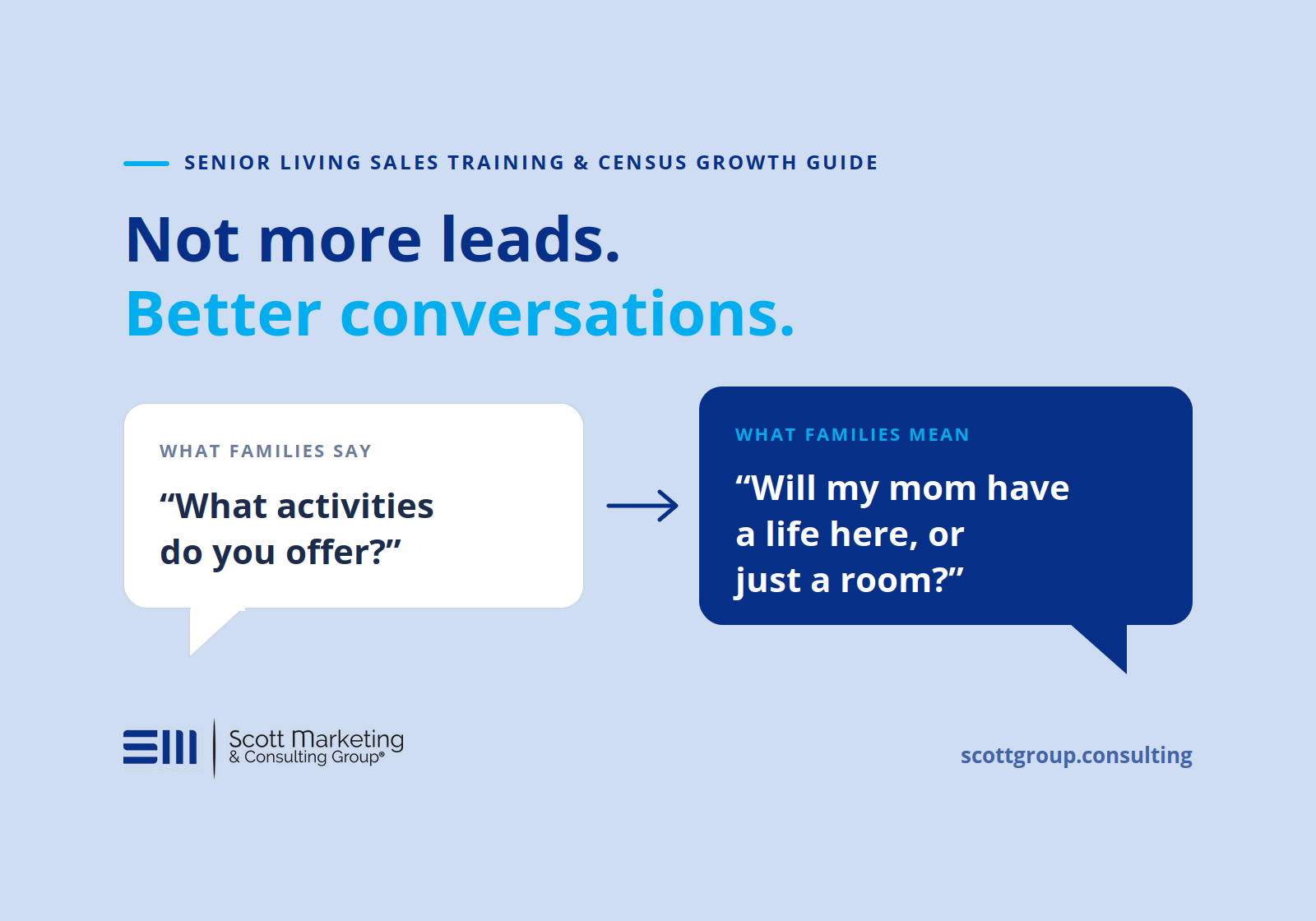
Senior Living Sales Training & Census Growth Guide



Sandra Scott is the CEO and Founder of Scott Marketing and Consulting Group® (SMCG®), a senior living and healthcare marketing agency serving small and midsize providers across the United States. A former VP of Sales & Marketing for three CCRCs, she managed sales and marketing generating more than $52 million in annual revenue. She was named 2023 Innovator of the Year by the Residential Assisted Living Association, and SMCG® was recognized as a Top GEO Agency (2026) by First Page Sage.
What is GEO for senior living? Generative Engine Optimization is the practice of structuring your content and online presence so AI systems like ChatGPT, Google AI, Perplexity and Gemini recommend your community when families ask for help finding care.
Here’s the main idea of this entire article: AI search doesn’t reward the communities with the loudest marketing. It rewards the communities it can verify.
That distinction changes everything about how census growth works. Traditional SEO got you found when a family searched your name. GEO gets you recommended before that family ever knows you exist. In 2026, by the time someone calls your community, an AI tool may have already told them whether you belong on their shortlist.
I’ve spent my career on both sides of this, first as VP of Sales & Marketing for three CCRCs, carrying census responsibility through $52M+ in annual sales, and now helping small and midsize providers compete in AI search. The operators earning those recommendations right now aren’t the ones with the biggest ad budgets. They’re the ones AI systems can verify and trust.
Families don’t research the way they did five years ago. They don’t start with the traditional ten blue links we’ve come to know and rely on over the years. They start with an online conversation with their preferred AI tool.
This is no longer fringe behavior. According to Pew Research Center’s June 2026 study, 49% of U.S. adults now use AI chatbots, up from 23% just three years ago, and 60% read the AI-generated summaries at the top of their search results, with searching for information as the most common use.1 The adult daughters and sons researching care for a parent sit squarely inside those numbers.
Conversations that look like these real questions families type into AI tools every day:
Notice what’s happening in those queries. The family is doing discovery, comparison, and shortlisting, the entire beginning of their decision, inside a single AI conversation.
And here’s the part most operators miss, families today arrive at your door further along than ever. The AI answered their early questions, compared their options, and shaped their expectations. Your first conversation with them is no longer their first conversation about you.
The decision didn’t move online. The elimination round did.
AI systems summarize content. And generic content disappears in a summary.
When an AI tool builds an answer about senior living options, it pulls from sources that say something specific, verifiable, and different. Content that says “we offer compassionate care in a warm, homelike environment” gives the AI nothing to cite because ten thousand communities say exactly the same thing.
If your website could belong to the community down the street, AI systems treat it as interchangeable.
What AI systems can actually extract and cite:
Generic content was always weak marketing to begin with. AI search just made the cost of generic content visible. Invisibility used to mean ranking on page two and up. Now it means being absent from the answer entirely.
Reviews have become one of the strongest inputs AI systems weigh when recommending senior living communities and not in the way most operators assume.
AI systems don’t just count stars. They read content. A review that says “the staff knew my mother’s name and her coffee order by day three” tells an AI system something verifiable about your community’s culture. Fifty reviews that say “nice place” tell it almost nothing.
Reviews are the new referral network. AI just made them even more visible.
This is why reputation management and GEO can’t be separated anymore: reviews are the trust engine of the Occupancy Flywheel™, made machine-readable. The specificity of your reviews (i.e., what families mention, how recent they are, how you respond) directly shapes whether AI tools present your community as recommendable to families. I’ve covered this in depth in our guide to reputation management in the AI era.
Your reviews are written by residents and families, not your marketing department.
And there’s one truth worth keeping in mind; every care plan meeting, every transition to a different level of care, every returned call either feeds your AI visibility or starves it.
This is the most encouraging thing I tell our client partners and all small or midsize providers I speak with: GEO is the first search environment in years where independent operators have a structural advantage.
Large corporate chains produce content at scale which means they produce templated content. Same pages, same language, city name swapped. AI systems are specifically built to discount that pattern.
What independent operators have that chains can’t manufacture:
When I ran sales inside CCRCs for a non-profit we didn’t have big budgets. Our communities performed well online because we had authentic stories and honed strategies. Today, AI search rewards exactly that at the precise moment large operators are flooding the internet with content that all sounds the same.
The playing field didn’t just get leveled because of AI. For operators willing to be authentic and specific, it tilted.
GEO isn’t a single tactic. It’s a trust infrastructure built across four layers:
Notice that none of these four layers is “more marketing volume.” Every one of them is a trust signal, and together they do for AI visibility what the Occupancy Flywheel™ does for census: compound quietly, then decisively. And if you want the step-by-step version, I’ve laid out the complete senior living GEO checklist, ten steps in order, most of them free, with an honest label on what you can do yourself. That’s the change. GEO is becoming the trust infrastructure behind modern occupancy growth.
And remember that visibility only starts the work. AI search delivers better informed families to your door. Your team still has to convert them. That’s why GEO and sales skills belong in the same census strategy, which I’ve laid out fully in our Senior Living Sales Training & Census Growth Guide.
GEO (Generative Engine Optimization) is the practice of optimizing your content and online presence so AI systems like ChatGPT, Google AI, and Perplexity recommend your community when families ask for help finding care. Unlike traditional SEO, which gets you found when someone searches, GEO gets you recommended inside AI-generated answers.
SEO targets rankings on search results pages and GEO targets citations and recommendations inside AI-generated answers. They share a foundation that includes trust signals, entity clarity, and quality content, but GEO emphasizes extractable answers like review specificity and verifiable expertise. Most communities now need both.
GEO typically produces initial AI mentions within three to six months, depending on your starting reputation, content depth, and entity consistency. Anyone promising AI visibility in 30 days is overpromising. AI systems reward sustained trust signals not quick fixes.
Yes, small senior living communities can compete in AI search and often more effectively than large chains. AI systems discount templated, duplicated content, which is what corporate scale tends to produce. Independent operators with specific, authentic, locally grounded content and detailed reviews have a genuine structural advantage in GEO.
Here’s a simple first step. Open ChatGPT or Google AI and ask the questions your families ask. “What is the best assisted living near [your city].” “Which memory care communities in [your area] have the strongest reputation?” See whether you’re in the answer.
If you’re not or if you’re not sure what to do about it, that’s exactly the work of our GEO services for senior living providers. Scott Marketing and Consulting Group® was recognized as a Top GEO Agency (2026) by First Page Sage, and we work exclusively with small and midsize senior living and healthcare providers across the United States.
Schedule a free 20-minute consultation for an honest conversation about where your community stands in AI search and what’s actually possible.
Source
[1] Pew Research Center.
“Americans and AI 2026: Chatbots, Smart Devices and Views on Impact.”
Accessed July 2026.
Explore More Strategies for AI Search & Visibility:

.jpg)